
Putting people first is one of the fundamental principles we work by at Nybble. Part of that commitment is exercising our social responsibility, putting our capabilities at the service of causes that are not linked to business, but are linked to the human side.
That's why when the TINC Foundation (Technologies that Include), through the Project DANE invited us to update their Sonigrama application, and we readily offered our commitment and talent. This is what this new edition of Nybble Bytes is all about.
Sonogram It's an app that stimulates musical intelligence and cognitive skills by recognizing sounds and animals. It was designed to support and enhance the development of people with various disabilities, becoming a tool for inclusion and learning. It hadn't been updated in a while, affected by constant changes in app store policies, and needed a complete redesign, both technically and in terms of user experience.
The challenge wasn't just updating the app, but redesigning it from scratch. The app's goal is to stimulate sound identification and associate them with images, developing fundamental skills for literacy and numeracy. Beyond its educational function, the app was conceived with an inclusive approach, addressing the specific ways in which people with disabilities and neurodivergent individuals interact with technology. In practice, this meant questioning many of our assumptions when designing: a color, an icon, a celebratory animation. These assumptions were tested against real-world needs.
What is DANE?
DANE is a project of the TINC Foundation aimed at developing inclusive technologies that facilitate learning and daily life for people with disabilities. It began in partnership with Pablo Fiuza In 2012, starting from a simple but little-attended idea: what is intuitive for a neurotypical person in handling an application (dragging an icon, understanding an icon, tolerating a visual stimulus) can represent a real barrier for a person with a different condition.
In more than a decade of work, the project developed around 15 applications for people with different disabilities and conditions, including Sonigrama.
Nybble's technical contribution
The first step was to rebuild the code, and leave the project ready to add the second platform when needed, something that previously involved maintaining two separate developments.
For the images, instead of using stock photos, they were generated with artificial intelligence tools, testing different models and prompts until the level of realism and variety the app needed was achieved: different breeds and colors of the same animal, in different shots and contexts, to produce original images and reduce reliance on stock photo libraries. The sounds, meanwhile, were taken from royalty-free audio libraries.
Design to include
The most in-depth work involved design. The team in charge of designing the User Experience, led by Natalia Daffunchio , certified in Accessibility, carried out a research process with educational psychologists and real users.
From this emerged an initial hypothesis that, over time, was reversed: less is more. The initial version was flashy and stimulating, the exact opposite of what a neurodivergent person needs. "You have to focus your attention on what's really needed," Nat explains.
This shift in perspective permeated every decision: from pastel colors to blues, from drawings to real photographs generated to avoid copyright issues, and from a traditional video game feedback system to one where mistakes are never visibly penalized. This last point arose after observing users' reactions to a red box.
Each round of feedback led to deconstructing and rethinking assumptions. "I felt closer to a world I hadn't really considered, and these are people with the same right to use technology as everyone else," she reflects. Juliana Rosas Project Manager.
What was the final product?
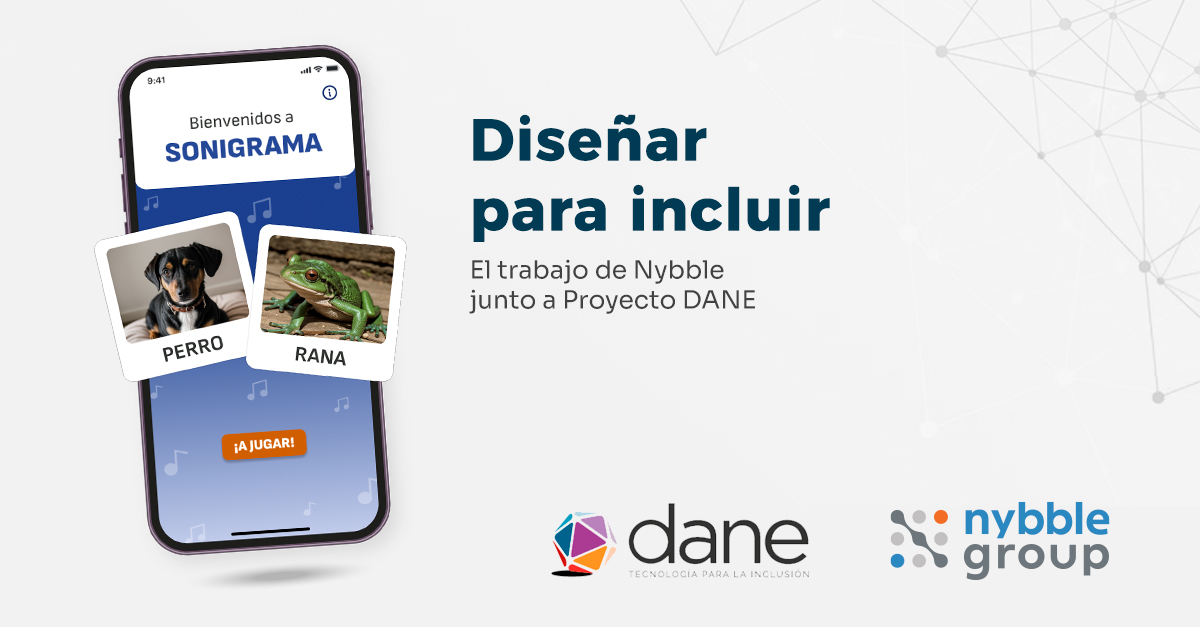
Sonigrama ended up with a simple, blue-background interface, featuring Polaroid-style cards that combine animal images and sounds, consistently positive feedback, and a gradual progression of difficulty, from fewer to more images on screen. The result was a clean and simple interface, ideal for achieving the stated objectives.
"We are very pleased with the professionalism and dedication the entire Nybble team brought to the project. They embraced the challenge of redesigning an inclusive app, with all that entails, learning and adopting the necessary guidelines for its development." Pablo Fiuza , president of TINC Foundation .
The app is available on the Android store, with plans to expand to other platforms and add new animal contexts in future versions.
Acknowledgments
Participating in these kinds of projects takes us out of the user role we typically assume. Every design assumption is tested against real-world needs, and that ultimately improves how we think about any product, not just this one. For us, the opportunity to add these kinds of pro bono collaborations to our work is part of what gives meaning to our profession.
"Working at DANE was different; it wasn't just solving another technical challenge. Knowing that I was helping to build something that could impact someone else's life gave weight to every line of code," he says. Uri Alcantar , FrontEnd Developer on this project.
At Nybble we value being able to be part of instances where technology literally fulfills the function of helping someone understand the world a little better.
We are deeply grateful to Pablo, Mariano, and the rest of the TINC team for their trust. And we don't want to end this story without acknowledging all the Nybblers who were part of it:
- Christian Coello Grassi (Technical Leader)
- Natalia Daffunchio (UX/UI Leader)
- Martina Lara Gros ros (UX/UI Designer)
- Juliana Rosas (Project Manager)
- Antonio Ortiz (Fullstack Developer)
- Uri Alcantar (FrontEnd Developer)
- Thiago Castenetto (FrontEnd Developer)
- Alvaro Torrez (QA Engineer)
We hope to be part of many more projects like this!